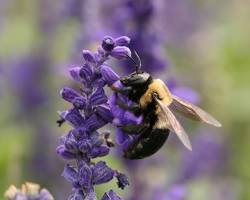
Xylocopa virginica (Eastern Carpenter Bee)
Xylocopa virginica, commonly known as the Eastern Carpenter Bee, is one of the largest native bee species found in North America. These solitary bees are important pollinators of many wildflowers, fruit trees, and garden plants. Despite their ecological value, they are often considered pests because females excavate tunnels in wood to create nesting galleries for their offspring.
Unlike termites or wood-boring beetles, Eastern Carpenter Bees do not consume wood for food. Instead, they remove wood fibers while constructing nests. A single nest causes minimal damage, but repeated nesting activity over multiple years can weaken wooden structures and create unsightly holes, staining, and structural deterioration.
The Eastern Carpenter Bee is frequently mistaken for a bumblebee due to its large size and black coloration. However, several key characteristics make identification relatively straightforward.
Taxonomy and Classification
- Kingdom: Animalia
- Phylum: Arthropoda
- Class: Insecta
- Order: Hymenoptera
- Family: Apidae
- Genus: Xylocopa
- Species: Xylocopa virginica
Eastern Carpenter Bees belong to the same family as honey bees and bumblebees. Unlike social bees that live in colonies, carpenter bees are solitary insects that construct and maintain individual nests.
Identification
Adult Eastern Carpenter Bees are large and robust insects measuring approximately 20–25 mm in length.
- Female: Large black bee with a shiny, hairless black abdomen.
- Male: Similar in size but distinguished by a white or yellow patch on the face.
- Color: Black body with yellow hairs on the thorax.
- Wings: Dark and slightly iridescent.
- Flight: Powerful and noisy.
The easiest way to distinguish a carpenter bee from a bumblebee is by examining the abdomen. Bumblebees have hairy abdomens, while carpenter bees have smooth, shiny abdomens.
Males are often seen hovering aggressively near nesting sites. Despite their intimidating behavior, males lack stingers and cannot sting.
Distribution and Habitat
Eastern Carpenter Bees are widespread throughout the eastern and southeastern United States.
They are commonly found in:
- Residential neighborhoods
- Gardens
- Parks
- Woodlands
- Agricultural areas
- Rural structures
These bees prefer untreated, weathered, or soft woods such as pine, cedar, redwood, cypress, and fir.
Common nesting locations include:
- Deck railings
- Porch supports
- Eaves and fascia boards
- Wooden fences
- Outdoor furniture
- Sheds and barns
Life Cycle
Eastern Carpenter Bees complete one generation annually in most regions.
- Spring Emergence: Adults emerge from overwintering sites.
- Mating: Males establish territories and court females.
- Nest Construction: Females bore tunnels into wood.
- Egg Laying: Eggs are deposited in individual brood chambers.
- Larval Development: Larvae feed on pollen and nectar provisions.
- Pupation: Development continues within the nest.
- Adult Emergence: New adults emerge during summer.
- Overwintering: Adults remain in protected galleries until the following spring.
Nesting Behavior
The female carpenter bee uses powerful mandibles to drill a nearly perfect circular entrance hole approximately 1/2 inch in diameter.
After entering the wood, the tunnel turns sharply and follows the grain. Nest galleries may extend several feet in length and contain multiple brood chambers separated by partitions made from chewed wood pulp.
Females often reuse existing tunnels and expand older galleries, increasing structural damage over time.
Damage and Economic Importance
The primary conflict associated with Eastern Carpenter Bees is structural wood damage.
Wood Tunneling
- Circular entrance holes.
- Long internal galleries.
- Repeated nest expansion.
- Structural weakening.
Wood Staining
Yellowish-brown fecal stains frequently appear beneath entrance holes.
Woodpecker Damage
Woodpeckers often attack infested wood while searching for larvae, causing additional structural damage.
Aesthetic Issues
- Visible holes.
- Sawdust accumulations.
- Staining.
- Buzzing activity around structures.
Signs of Infestation
Common indicators include:
- Perfectly round entrance holes.
- Coarse sawdust beneath holes.
- Yellow staining below nests.
- Large bees hovering around structures.
- Buzzing sounds from wooden surfaces.
- Woodpecker damage near nesting sites.
Behavior and Conflict
The primary conflict arises from nesting activity rather than aggressive behavior.
- Wood Excavation: Females tunnel into structural wood.
- Nest Reuse: Existing galleries are expanded over time.
- Territorial Males: Males may hover aggressively around people.
- Pollination Benefits: Adults provide valuable pollination services.
Because they are important native pollinators, management strategies should focus on prevention and targeted treatment rather than indiscriminate elimination.
Management and Prevention
Integrated Pest Management (IPM) is the preferred approach.
Prevention
- Paint or Stain Wood: Painted surfaces are less attractive for nesting.
- Use Treated Lumber: Pressure-treated wood is less susceptible.
- Seal Cracks: Reduce attractive nesting sites.
- Replace Damaged Wood: Remove heavily infested material.
Targeted Treatment
- Apply insecticidal dust into active galleries.
- Wait several days before sealing holes.
- Plug entrances using wood putty or caulk.
- Paint repaired surfaces.
Monitoring
- Inspect structures each spring.
- Watch for hovering males.
- Identify new entrance holes early.
Conservation and Research
Research focuses on balancing carpenter bee conservation with structural protection. Scientists are developing non-lethal deterrents, specialized coatings, and habitat alternatives that discourage nesting in buildings while preserving populations of these valuable pollinators.
Eastern Carpenter Bees play an important ecological role as pollinators throughout eastern North America. While their nesting activity can damage wooden structures, proper maintenance, exclusion, and targeted management can minimize conflicts while allowing these beneficial native insects to continue supporting healthy ecosystems.