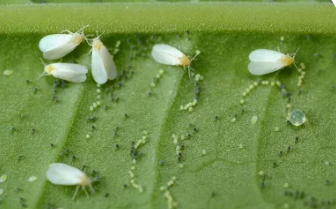
Whiteflies are tiny sap-sucking insects belonging to the family Aleyrodidae. Despite their name, they are not true flies but are more closely related to aphids, mealybugs, and scale insects. Whiteflies are among the most important agricultural and greenhouse pests worldwide, attacking hundreds of species of vegetables, ornamentals, fruit crops, and landscape plants.
These insects are recognized by their powdery white wings and tendency to gather on the undersides of leaves. When disturbed, adults often rise from plants in small white clouds, making infestations easy to recognize. Whiteflies cause damage through direct feeding, honeydew production, and transmission of destructive plant viruses. Heavy infestations can weaken plants, reduce yields, and create serious economic losses in commercial agriculture.
Because they reproduce rapidly and often develop resistance to insecticides, whiteflies are considered one of the most challenging pests to manage in both outdoor crops and greenhouse environments.
Taxonomy and Classification
- Kingdom: Animalia
- Phylum: Arthropoda
- Class: Insecta
- Order: Hemiptera
- Family: Aleyrodidae
Important pest species include:
- Silverleaf Whitefly (Bemisia tabaci)
- Greenhouse Whitefly (Trialeurodes vaporariorum)
- Citrus Whitefly (Dialeurodes citri)
- Woolly Whitefly (Aleurothrixus floccosus)
Many whitefly species have broad host ranges and can infest numerous cultivated and wild plants.
Identification
Whiteflies are among the smallest visible plant pests.
- Size: 1 mm to 3 mm long.
- Color: White, cream-colored, or pale yellow.
- Wings: Covered with a white waxy powder.
- Body Shape: Small, triangular appearance when at rest.
- Location: Usually found on leaf undersides.
Eggs
Females lay tiny oval eggs on the undersides of leaves.
- Yellow to pale white.
- Attached by a short stalk.
- Often laid in circular patterns.
Nymphs
Immature whiteflies resemble tiny scales.
- Flat and oval.
- Pale green or translucent.
- Remain attached to feeding sites.
- Nearly immobile after settling.
Pupae
The final immature stage develops within a scale-like structure known as a puparium.
Distribution and Habitat
Whiteflies occur worldwide and are especially abundant in warm climates.
Common habitats include:
- Vegetable gardens
- Greenhouses
- Nurseries
- Agricultural fields
- Fruit orchards
- Landscape plantings
- Indoor plants
They thrive in warm temperatures and can reproduce year-round in protected environments.
Life Cycle
Whiteflies undergo incomplete metamorphosis with several distinct developmental stages.
- Egg Stage: Eggs are laid on leaf undersides.
- Crawler Stage: Newly hatched nymphs move briefly before selecting a feeding site.
- Nymph Stage: Multiple immature stages occur while feeding on plant sap.
- Pupal Stage: Development continues inside a protective puparium.
- Adult Stage: Winged adults emerge and begin reproduction.
Under favorable conditions, the life cycle may be completed in as little as three weeks, allowing populations to increase rapidly.
Host Plants
Whiteflies attack hundreds of plant species.
- Tomatoes
- Peppers
- Cucumbers
- Squash
- Beans
- Cotton
- Citrus
- Poinsettias
- Hibiscus
- Numerous greenhouse crops
Their broad host range contributes significantly to their success as agricultural pests.
Damage and Economic Importance
Sap Feeding
Whiteflies feed by inserting specialized mouthparts into plant tissues.
- Leaf yellowing.
- Wilting.
- Reduced vigor.
- Stunted growth.
- Premature leaf drop.
Heavy infestations can significantly weaken plants.
Honeydew Production
Whiteflies excrete excess sugars as sticky honeydew.
- Sticky leaves.
- Contaminated fruit.
- Attraction of ants.
- Reduced plant appearance.
Sooty Mold
Honeydew supports the growth of black sooty mold fungi.
- Black coating on leaves.
- Reduced photosynthesis.
- Aesthetic damage.
- Reduced marketability.
Virus Transmission
The most serious damage often results from disease transmission.
- Tomato Yellow Leaf Curl Virus.
- Cucumber Mosaic Virus.
- Begomoviruses.
- Numerous crop diseases.
Virus transmission can result in complete crop failure in severe cases.
Signs of Infestation
- White insects flying when plants are disturbed.
- Clusters beneath leaves.
- Sticky honeydew deposits.
- Black sooty mold growth.
- Yellowing foliage.
- Reduced plant vigor.
Regular scouting is essential because populations often develop unnoticed on leaf undersides.
Management and Prevention
Integrated Pest Management (IPM) provides the most effective long-term control.
Cultural Control
- Remove heavily infested plants.
- Control weeds that serve as hosts.
- Maintain plant health.
- Improve greenhouse sanitation.
Monitoring
- Inspect leaf undersides regularly.
- Use yellow sticky traps.
- Monitor population trends.
- Detect infestations early.
Physical Control
- Strong water sprays.
- Vacuuming greenhouse populations.
- Removing infested leaves.
These methods can significantly reduce numbers in small infestations.
Biological Control
- Parasitic wasps (Encarsia formosa).
- Lady beetles.
- Lacewings.
- Predatory mites.
Beneficial insects are widely used in commercial greenhouse production.
Chemical Control
Insecticides may be necessary for severe infestations.
- Insecticidal soaps.
- Horticultural oils.
- Systemic insecticides.
- Targeted foliar treatments.
Rotation of active ingredients is critical because whiteflies develop resistance quickly.
Research and Future Management
Researchers continue developing sustainable whitefly management strategies, including resistant crop varieties, improved biological controls, and innovative monitoring technologies. Understanding virus transmission and insecticide resistance remains a major focus of whitefly research worldwide.
Advances in integrated pest management are helping growers reduce pesticide use while maintaining effective control of these highly adaptable pests.
Conclusion
Whiteflies are destructive sap-feeding pests capable of causing extensive economic losses through direct feeding, honeydew production, sooty mold development, and transmission of devastating plant viruses. Their rapid reproduction and ability to develop resistance make them challenging pests to control. Successful management depends on early detection, biological control, cultural practices, and carefully integrated pest management programs.