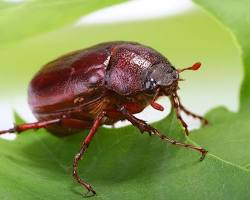
June Bugs (Phyllophaga spp.), also called May Beetles, are large scarab beetles widely known for their noisy nighttime flight and destructive underground larvae called white grubs. Adult June Bugs emerge during late spring and early summer, often clustering around porch lights and windows, while their larvae spend one to three years underground feeding on grass roots and ornamental plants.
Although adult June Bugs can feed on tree foliage and shrubs, the primary damage comes from the grub stage. White grubs live beneath lawns and gardens where they chew through root systems, causing turf to wilt, yellow, and eventually die. Heavy infestations may leave lawns weak enough to be peeled back like loose carpet.
June Bugs are among the most common turfgrass pests in North America and are particularly problematic in irrigated lawns, golf courses, parks, and suburban landscapes. Their long life cycle and overlapping generations make infestations difficult to eliminate quickly.
Quick Facts
- Scientific Group: Phyllophaga spp.
- Common Names: June Bugs, May Beetles
- Order: Coleoptera
- Family: Scarabaeidae
- Main Conflict: Turfgrass root destruction
- Habitat: Lawns, gardens, forests, landscapes
- Diet: Roots, leaves, foliage
- Status: Major turfgrass pests
Taxonomy and Classification
June Bugs belong to the order Coleoptera and the family Scarabaeidae, the same family that includes scarab beetles, rhinoceros beetles, and Japanese beetles.
The genus Phyllophaga contains hundreds of species native to North America. Their scientific name means “leaf eater,” referring to the adult beetles’ habit of feeding on plant foliage. Adults are commonly called June Bugs because they typically emerge in greatest numbers during May and June. :contentReference[oaicite:0]{index=0}
These beetles undergo complete metamorphosis consisting of:
- Egg
- Larva (white grub)
- Pupa
- Adult
Depending on species and climate, their life cycle may require one, two, or even three years to complete. :contentReference[oaicite:1]{index=1}
Physical Description
Adult June Bugs are medium to large scarab beetles measuring approximately 1/2 to 1 inch long.
Adult Appearance
- Reddish-brown to dark brown coloration
- Heavy oval-shaped body
- Hard wing covers (elytra)
- Spiny legs
- Clumsy nighttime flight
Adults are nocturnal and strongly attracted to lights, often flying erratically into windows, walls, and porch fixtures. :contentReference[oaicite:2]{index=2}
White Grubs
The larval stage is the destructive phase responsible for most damage.
- Creamy white coloration
- Distinct C-shaped posture
- Brown head capsule
- Six legs near the head
- Found beneath soil surfaces
White grubs feed directly on turfgrass roots and ornamental plants. :contentReference[oaicite:3]{index=3}
Damage Signs
Common symptoms of infestation include:
- Irregular brown lawn patches
- Spongy turf
- Grass pulling up easily
- Wilting despite watering
- Skunk or raccoon digging damage
- Bird feeding activity on lawns
Secondary animal damage often becomes the first noticeable sign because predators dig through lawns searching for grubs. :contentReference[oaicite:4]{index=4}
Distribution and Habitat
June Bugs are native throughout North America and occur in nearly every region with grass, ornamental landscapes, or forest vegetation.
Adults are commonly found:
- Around porch lights
- In forests and woodlands
- On ornamental trees
- In suburban neighborhoods
- Near agricultural fields
Larvae inhabit:
- Lawns
- Golf courses
- Pastures
- Garden beds
- Moist soil rich in roots
Females strongly prefer healthy, irrigated turfgrass for egg laying because moist soils improve larval survival. :contentReference[oaicite:5]{index=5}
Behavior and Conflict
The primary conflict associated with June Bugs involves the destructive feeding behavior of white grubs underground.
Adult Feeding
Adult June Bugs feed on:
- Tree leaves
- Shrub foliage
- Flowers
- Fruit tree leaves
Adult feeding usually causes only minor damage compared to the grub stage. :contentReference[oaicite:6]{index=6}
Root Destruction
White grubs feed aggressively on:
- Turfgrass roots
- Garden plants
- Vegetable roots
- Ornamental roots
Root loss prevents grasses from absorbing water and nutrients properly, causing drought-like symptoms even when irrigation is adequate. :contentReference[oaicite:7]{index=7}
Multi-Year Development
Some June Bug species require up to three years to complete development underground. :contentReference[oaicite:8]{index=8}
This extended development means:
- Multiple generations may overlap
- Damage can persist for years
- Population outbreaks may occur cyclically
Nocturnal Nuisance
Adult beetles become highly active at night and are strongly attracted to:
- Porch lights
- Street lamps
- Flood lights
- Windows
Their loud buzzing flight and tendency to crash into objects make them a common summer nuisance. :contentReference[oaicite:9]{index=9}
Life Cycle
Egg Stage
Females burrow several inches into the soil and deposit eggs in grassy or vegetated areas.
Eggs hatch within:
- 2–4 weeks depending on temperature
:contentReference[oaicite:10]{index=10}
Larval Stage
White grubs feed underground for one to three years depending on species and climate.
Grubs move deeper into the soil during winter and return near the surface during spring and fall feeding periods. :contentReference[oaicite:11]{index=11}
Pupal Stage
Mature larvae pupate within underground chambers during spring or early summer.
Adult Emergence
Adults emerge from the soil in late spring and early summer to mate and feed. Peak flights often occur during May and June. :contentReference[oaicite:12]{index=12}
Management and Prevention
Effective June Bug management focuses primarily on targeting white grubs before severe turf damage develops.
Lawn Maintenance
Healthy turf tolerates grub feeding better than stressed lawns.
- Water deeply but infrequently
- Mow at taller heights
- Avoid excessive nitrogen fertilization
- Encourage deep root systems
Biological Control
Beneficial biological controls include:
- Beneficial nematodes
- Milky spore bacteria
- Natural predators
- Bird activity
Beneficial nematodes are most effective when applied in late summer while young grubs are feeding near the soil surface. :contentReference[oaicite:13]{index=13}
Preventive Treatments
Preventive insecticides may be applied in early summer before eggs hatch.
Timing is critical because smaller grubs are much easier to control than mature larvae. :contentReference[oaicite:14]{index=14}
Curative Treatments
Existing infestations may require faster-acting treatments during late summer or early fall while grubs are actively feeding.
Outdoor Lighting Reduction
Reducing bright white lighting around buildings can help decrease adult attraction and egg-laying activity.
- Use yellow bulbs
- Limit unnecessary lighting
- Switch to sodium vapor lighting
Interesting Facts About June Bugs
- Some species spend up to three years underground as grubs.
- Adults are poor fliers and often crash into objects.
- White grubs are prized fishing bait.
- Small grub populations can slightly aerate soil.
- June Bugs belong to the scarab beetle family.
Conservation and Research
Research involving June Bugs focuses on:
- Improved grub monitoring methods
- Biological control timing
- Nematode effectiveness
- Turfgrass resistance
- Reduced pesticide dependence
Scientists are also studying how irrigation practices, lawn species selection, and climate conditions influence grub outbreaks in urban turfgrass systems.