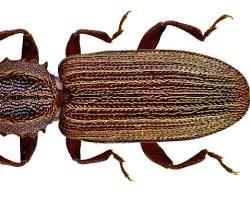
Grain Beetles is a general term referring to several small beetles that infest stored grains and other dry food products. These insects are among the most destructive storage pests worldwide and are responsible for major economic losses in agriculture, food processing, and residential food storage.
Grain beetles are commonly divided into two primary groups: Internal Feeders, such as the Rice Weevil (Sitophilus oryzae), and External or Secondary Feeders, such as the Saw-toothed Grain Beetle (Oryzaephilus surinamensis). Internal feeders develop inside whole grain kernels, while external feeders attack damaged grain, processed foods, and grain debris.
Heavy infestations can contaminate food products with insect fragments, shed skins, webbing, frass, and foul odors. Large infestations may also generate moisture and heat that encourage mold growth and spoilage within stored grain masses.
Quick Facts
- Order: Coleoptera
- Families: Curculionidae, Silvanidae, Cucujidae
- Habitat: Silos, warehouses, pantries, food storage areas
- Diet: Stored grain and dry food products
- Status: Major stored product pest
- Size: Approximately 1/16 to 1/8 inch long
- Life Cycle: Complete metamorphosis
Taxonomy and Classification
Grain Beetles belong to the order Coleoptera, the largest order of insects commonly known as beetles. Several different beetle families contain species considered grain pests.
Important grain beetle groups include:
- Curculionidae: Weevils such as the Rice Weevil and Granary Weevil
- Silvanidae: Saw-toothed Grain Beetles and Merchant Grain Beetles
- Cucujidae: Flat grain beetles
- Tenebrionidae: Flour beetles and darkling beetles
These beetles undergo complete metamorphosis with egg, larva, pupa, and adult stages. Their rapid reproductive rates and ability to thrive in warm, dry food storage environments make them persistent pests in commercial and residential settings.
Physical Description
Grain beetles are typically very small, ranging from approximately 1/16 to 1/8 inch long. Coloration varies from reddish-brown to dark brown or black depending on species.
Weevils (Internal Feeders)
Weevils possess a distinctive elongated snout called a rostrum. Their bodies are cylindrical and robust. Female weevils use the rostrum to bore holes into grain kernels where eggs are deposited.
The larva develops entirely inside a single grain kernel, hidden from view until the adult emerges through a perfectly round exit hole.
Saw-toothed Grain Beetles (External Feeders)
The Saw-toothed Grain Beetle is flattened and reddish-brown with six distinct saw-like projections on each side of the thorax. These beetles are fast-moving and commonly found in flour, cereal, pasta, and processed grain products.
Unlike internal feeders, their larvae feed externally on damaged kernels, grain dust, and processed foods.
Signs of Infestation
Heavy infestations often produce:
- Live beetles in food packages
- Round holes in grain kernels
- Webbing and clumping in food
- Frass (insect excrement)
- Shed skins and insect fragments
- Sour or musty odors
- Visible grain dust buildup
Distribution and Habitat
Grain beetles are cosmopolitan pests found worldwide wherever grain and dry food products are stored. They thrive in warm environments with abundant food supplies and limited disturbance.
Common infestation sites include:
- Grain silos
- Warehouses
- Food processing plants
- Pantries
- Feed storage bins
- Pet food containers
- Retail grocery storage areas
They infest not only whole grains such as wheat, rice, corn, oats, and barley, but also processed products including:
- Flour
- Pasta
- Cereal
- Crackers
- Dried fruit
- Spices
- Birdseed
- Pet food
Behavior and Damage
Grain beetles cause damage through both feeding and contamination. Different species attack stored products in different ways.
Internal Feeders (Primary Damage)
Internal feeders attack whole, intact grain kernels. Female weevils chew into kernels, lay eggs, and seal the openings. The developing larvae consume the grain from the inside, destroying nutritional value and reducing product weight.
Adults later emerge through round exit holes, leaving behind hollow kernels.
External Feeders (Secondary Damage)
Secondary feeders attack broken grain, grain dust, and processed foods. Massive populations may develop quickly in warehouses or pantries with poor sanitation.
Heavy infestations may create “hot spots” inside grain masses where insect activity raises temperature and moisture levels. These conditions often encourage mold growth and spoilage.
Economic Impact
Grain beetles are responsible for major agricultural and commercial losses worldwide. Infestations reduce:
- Food quality
- Nutritional value
- Product weight
- Market value
- Seed viability
Severe infestations may lead to rejection of entire grain shipments by buyers and food processors.
Life Cycle
The grain beetle life cycle includes egg, larva, pupa, and adult stages. Development speed depends heavily on temperature and humidity.
Females lay eggs directly into grain kernels, cracks, food debris, or processed food products. Larvae hatch and begin feeding immediately.
Larval development may take several weeks under warm conditions. After pupation, adults emerge and begin reproducing rapidly.
Under ideal conditions, some species can complete development in as little as one month, allowing multiple overlapping generations per year.
Management and Prevention
Effective control relies on rigorous sanitation and environmental management.
Sanitation
Eliminate all residual grain and food debris from storage areas, pantry shelves, cracks, and corners. Grain beetles often survive in tiny accumulations of spilled food.
Airtight Storage
Store dry foods in sealed glass, metal, or thick plastic containers. Thin cardboard and paper packaging are easily penetrated by many species.
Temperature and Moisture Control
Bulk grain should be cooled and dried properly to reduce reproduction and spoilage. Grain aeration systems are commonly used in commercial storage.
Inspection
Regularly inspect stored foods for:
- Live insects
- Clumped grain
- Exit holes
- Odors
- Fine powder or dust
Chemical Control
Severe infestations in commercial grain storage facilities may require fumigation or professional insecticide treatments. Residential infestations are usually managed by discarding contaminated foods and cleaning storage areas thoroughly.
Pheromone traps are commonly used to monitor grain beetle activity in warehouses and food storage facilities.
Interesting Facts About Grain Beetles
- Some grain beetles can survive on extremely dry foods.
- Weevil larvae develop completely inside grain kernels.
- Grain beetles are among the world’s oldest stored product pests.
- Heavy infestations can increase grain temperature dramatically.
- Some species can fly long distances to locate new food sources.