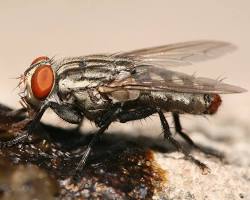
Flesh Flies are medium-sized flies belonging to the family Sarcophagidae. These flies are widely distributed around the world and are commonly associated with carrion, decaying organic matter, garbage, animal waste, and other protein-rich decomposing materials. Unlike many other common fly species, most Flesh Flies are larviparous, meaning females deposit live larvae instead of laying eggs. This reproductive strategy allows their offspring to begin feeding immediately after deposition.
Although many Flesh Fly species are harmless scavengers that help decompose dead organic material, some species are medically and veterinary important. Certain Flesh Flies may contribute to disease transmission or cause myiasis, a condition where fly larvae infest living tissue or open wounds. In addition, these flies play an important role in forensic entomology because their predictable arrival and development on carrion can help investigators estimate the time since death.
Flesh Flies are often mistaken for Blow Flies or House Flies, but their distinctive striped thorax and checkered abdomen help distinguish them from other common fly species.
Taxonomy and Classification
- Kingdom: Animalia
- Phylum: Arthropoda
- Class: Insecta
- Order: Diptera
- Family: Sarcophagidae
- Genus: Sarcophaga and related genera
- Common Name: Flesh Flies
Flesh Flies belong to the order Diptera, the true flies, and undergo complete metamorphosis with egg, larva, pupa, and adult stages.
The family Sarcophagidae contains hundreds of species worldwide, many with highly specialized feeding and breeding behaviors. Some species are scavengers, others are parasites, and a few are predators or decomposers associated with animal remains.
The genus Sarcophaga contains many of the most commonly encountered species associated with carrion and decaying organic material.
Physical Description
Adult Flesh Flies are robust flies typically measuring between 1/4 and 1/2 inch long. Their body structure resembles that of House Flies, but they are usually larger and more heavily built.
Key identifying features include:
- Gray thorax with three dark black stripes
- Distinctive checkered gray and black abdomen
- Large reddish-brown compound eyes
- Strong bristly body
- Transparent wings
- Rapid active flight behavior
The checkered or mottled abdominal pattern is one of the easiest ways to identify Flesh Flies.
The larvae, commonly called maggots, are creamy white, legless, cylindrical, and tapered toward the head. Like many fly larvae, they are highly adapted for feeding within soft decaying tissues.
Pupae develop within hardened reddish-brown puparia, usually hidden in soil, debris, or nearby protected areas.
Distribution and Habitat
Flesh Flies are cosmopolitan and occur in nearly all regions of the world. They are especially common in warm environments where decaying organic material is available.
Preferred habitats include:
- Garbage areas
- Animal carcasses
- Livestock facilities
- Pet waste accumulation sites
- Compost piles
- Sewage areas
- Roadkill sites
- Outdoor food waste locations
These flies are strongly attracted to decomposing meat, carrion, feces, and protein-rich organic material because such environments provide food for developing larvae.
In urban and suburban areas, Flesh Flies are frequently found around dumpsters, garbage bins, animal shelters, pet waste, and neglected food waste.
Life Cycle
Flesh Flies undergo complete metamorphosis consisting of four stages:
- Larva (deposited live)
- Larval feeding stages
- Pupa
- Adult
Unlike many flies that lay eggs, most Flesh Fly females deposit living first-stage larvae directly onto food sources. This behavior is called larviposition.
By skipping the external egg stage, Flesh Fly larvae gain an important competitive advantage because they begin feeding immediately after deposition.
Larvae develop rapidly while feeding on carrion, feces, wounds, or other organic material. After reaching maturity, they leave the feeding site and pupate in nearby protected areas such as soil or debris.
Under favorable warm conditions, development may occur quickly, allowing multiple generations per year.
Behavior and Feeding
Flesh Flies are highly attracted to odors associated with decomposition and protein breakdown. Adults use specialized sensory organs to locate carrion, waste, and breeding sites from considerable distances.
Adult flies commonly feed on:
- Liquid organic material
- Carrion fluids
- Animal waste
- Decaying food
- Nectar and sugary substances
Larvae primarily feed on:
- Carrion
- Decaying flesh
- Animal waste
- Organic refuse
- Living tissue in cases of myiasis
Many Flesh Fly species are beneficial scavengers because they help break down dead organic material and recycle nutrients back into ecosystems.
Medical and Veterinary Importance
Flesh Flies are important from both medical and veterinary perspectives because of their potential role in disease transmission and myiasis.
Disease Transmission
Adult flies frequently move between decaying organic matter and human environments. As a result, they may mechanically carry bacteria and pathogens on their bodies and mouthparts.
Potential contamination risks include:
- Food contamination
- Bacterial transfer
- Unsanitary conditions around waste
- Spread of pathogens from carrion or feces
Myiasis
Some Flesh Fly species are capable of causing myiasis, a condition where larvae infest living tissue or wounds.
Myiasis may affect:
- Livestock
- Wild animals
- Pets
- Humans in rare cases
Infestations usually occur in:
- Open wounds
- Ulcers
- Necrotic tissue
- Poorly maintained animal bedding
Myiasis requires prompt veterinary or medical treatment to remove larvae and prevent secondary infection.
Forensic Entomology
Flesh Flies are extremely important in forensic science. Because they arrive quickly on carrion and develop at predictable rates, forensic entomologists use their larval stages to estimate the Post Mortem Interval (PMI), or time since death.
Scientists analyze:
- Larval size and age
- Pupal development
- Species identification
- Environmental temperature
These data help investigators reconstruct timelines during death investigations.
Signs of Infestation
- Medium gray flies around garbage or carrion
- Strong attraction to decaying meat or waste
- Maggots present in organic material
- Checkered gray-black flies resting on walls or containers
- Persistent fly activity near dumpsters or animal waste
Management and Control (IPM)
Effective management of Flesh Flies relies primarily on sanitation and source reduction.
Sanitation
Remove decaying organic material promptly. Dispose of dead animals, spoiled food, pet waste, and garbage regularly.
Use tightly sealed garbage containers and empty them frequently to reduce breeding opportunities.
Exclusion
Install and maintain window and door screens to prevent adult flies from entering buildings.
Seal structural gaps around doors, vents, and utility openings.
Trapping
Sticky traps and baited fly traps can reduce adult populations around garbage areas and livestock facilities.
Protein-based baits such as fish or meat are often highly attractive to Flesh Flies.
Chemical Control
Residual insecticides may be applied to outdoor resting surfaces, dumpsters, livestock structures, and waste-handling areas when necessary.
However, chemical treatment is generally considered secondary to proper sanitation and waste management.
Ecological Importance
Although often viewed as nuisance pests, Flesh Flies play valuable ecological roles as decomposers and scavengers. By feeding on carrion and decaying organic material, they help recycle nutrients and accelerate decomposition processes.
They also serve as food for birds, spiders, predatory insects, and other animals within natural ecosystems.
Research and Conservation
Researchers study Flesh Flies extensively in:
- Forensic entomology
- Medical entomology
- Decomposition ecology
- Disease transmission research
- Fly trapping and monitoring systems
Current studies focus on understanding the chemical signals Flesh Flies use to locate carrion and improving fly management strategies in agricultural and urban environments.
Conclusion
Flesh Flies are medium-sized gray flies recognized by their striped thorax, checkered abdomen, and unusual habit of depositing live larvae instead of eggs. While many species are harmless scavengers that help decompose organic matter, others may contribute to disease contamination or cause myiasis in animals and humans. Their importance in forensic entomology also makes them scientifically valuable. Effective management depends on sanitation, waste removal, exclusion, and reducing breeding sources around homes, farms, and commercial facilities.